open-atomic-bomberman-97
Open Bomberman is a C++20 rewrite of Atomic Bomberman that adds online multiplayer and supports original assets.
- Type: PC port
- Game: Atomic Bomberman
- Runs on Windows
- By Egerion
- Latest release v1.0.0, 2026-08-01
- Source: https://github.com/Egerion/open-atomic-bomberman-97
README
Open Bomberman
A clean-room, modern C++20 rewrite of Atomic Bomberman (Interplay, 1997) — a deterministic re-implementation that renders the original game with the assets from your own copy, and adds online multiplayer the 1997 game never shipped in a form that survives modern networks.
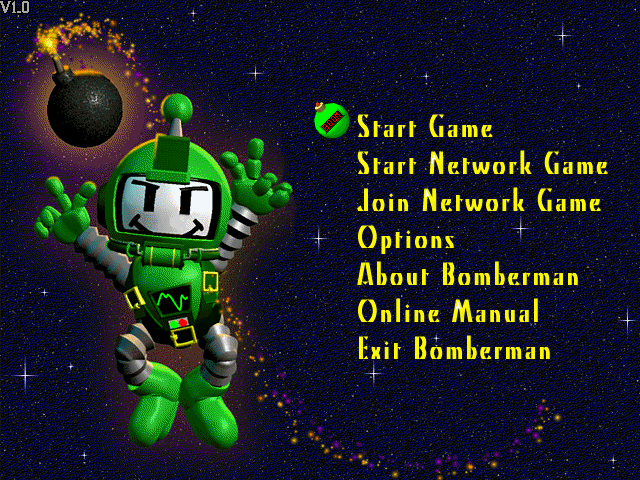
Status: playable. Faithful deterministic sim (movement, bombs, kick/punch/grab/throw, spooger, the nine diseases, HURRY wall-close, conveyors/warpholes/trampolines, head hits), original art/sound/music loaded at runtime, random stage rotation, and a scheme editor — plus online multiplayer over the internet: share a 6-character lobby code or list your match publicly, and the peers punch a direct UDP path (falling back to a relay when a NAT refuses one) and play on GGPO-style rollback netcode with no input delay. The host sets the match up in the game's own roster and level screens while guests watch, so map choice and AI slots work online exactly as they do locally, and a lobby holds up to ten machines — fill the rest of the board with AI if you have fewer.
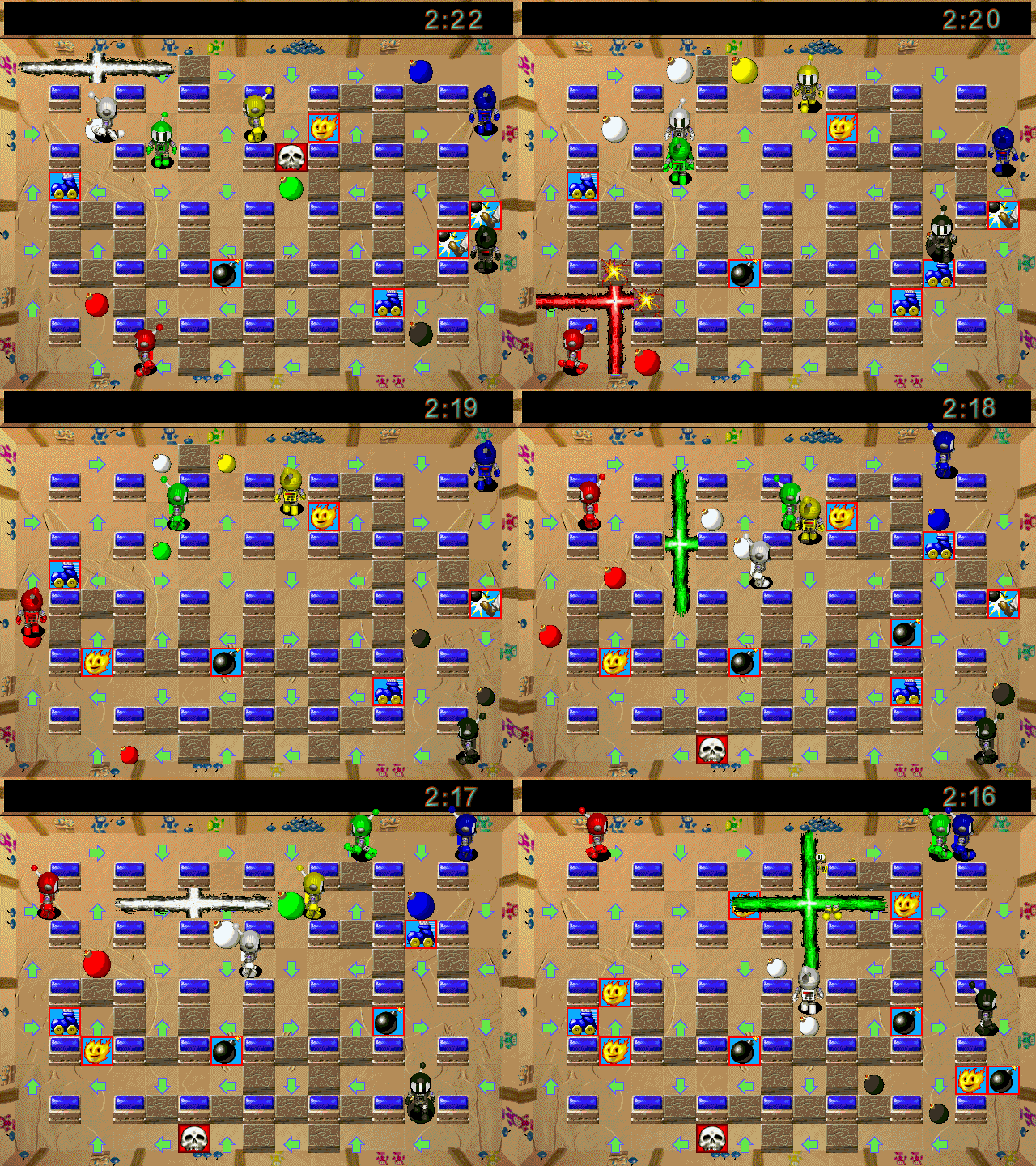
The screenshot and the animation show the clean-room engine running with the original game's assets, loaded at runtime from a copy you own — see Legal. The animation is an unedited headless capture of the deterministic sim — six computer players, six seconds of one round, one frame per 20 Hz tick — rendered straight to disk by
--demo-shotswith no display attached.
Built entirely with Claude Code — no code typed by hand
This is an experiment in fully AI-authored software. Every line in this repository — the reverse-engineering notes, the clean-room C++ port, the deterministic simulation, the SDL3 presentation layer, the test suites, the online netcode, and the build system — was written by Claude (Anthropic's coding agent, driven through Claude Code) from natural-language direction. No source was written by hand.
The human's role was product direction and reverse-engineering guidance — "here's what the original does, make ours match", "the enclosure wall renders wrong", "make multiplayer smooth" — plus running the result and validating it in-game. Claude did the RE distillation, the faithful ports of the original's arithmetic, the tests that pin behaviour, and the netcode. The workflow that made it tractable is the same discipline any team would use: a deterministic core with golden-hash tests, reverse-engineering facts written down before they're ported (docs/re/), and decisions recorded as ADRs (docs/adr/).
Features
- Faithful, deterministic gameplay core — integer-only 20 Hz sim, ported to mirror the original binary's arithmetic (not paraphrased), with golden-hash tests that freeze behaviour against accidental change.
- Original assets at runtime — reads the 1997 ANI/PCX/SCH/RES/RSS formats from your own install; nothing is bundled.
- Online multiplayer — deterministic lockstep and GGPO-style rollback over UDP, with per-tick
state_hashdesync detection and packet-loss tolerance; play from the menu (Start / Join Network Game) or the command line. - Presentation extras with no 1997 equivalent — HD art toggle, a native-cadence "creamy" low-latency mode (F9), FPS/vsync toggles, and an optional soft (bilinear) upscale for anyone who prefers the smoothed look a modern display scaler gives the 640x480 image — all default-off, and all kept off the faithfully-reproduced Options screen (they live in the port's own F10 panel).
- Tools — a headless asset inspector/extractor (
abtool), an animation viewer (bomber_viewer), and a scheme editor.
Layout
The SDL-free core:
libs/core     shared vocabulary: fixed-point unit, field geometry, limits — header-only, no deps
libs/assets   loaders for the original formats (ANI, PCX, SCH, RES, RSS) — SDL-free
libs/sim      deterministic 20 Hz gameplay core (state + systems) — dependency-free
libs/match    scheme + VALUELST -> MatchConfig glue (header-only)
libs/net      online netcode: input codec, lockstep + rollback sessions, UDP transport, lobby client — SDL-free
libs/audio    AudioEngine + SoundBank (the ported selection engine) + SoundDirector
libs/platform engine base: SDL3 frame clock + an SDL-free, unit-tested frame pacer
The presentation stack — nine packages, arrows pointing one way only, split out
of what was a single 13k-line libs/game:
libs/game_util  SDL-FREE models: front-end state machine, results bookkeeping, pixel/pacing rules
libs/input      keyboard, gamepad, DOS-scancode bridge (SDL-free public headers)
libs/render     AssetStore, sprites, sequences, the world Renderer
libs/ui         Screen/ScreenContext, the .BM text viewer, window/dialog/list chrome
libs/netui      net widgets drawn inside another screen: chat overlay, setup link, F3 panel
libs/editor     the .SCH scheme editor's SDL surface
libs/frontend   every screen the player sees, plus MatchRunner
libs/netplay    the online session end to end: lobby, connect/host, best-of-N match
libs/game       the application shell: GameApp — SDL/window lifetime and the AppState loop
apps/         bomber_game (OPEN-BM95), bomber_viewer, abtool (thin mains)
services/     matchmaker (Go, separate build): lobby control plane + STUN + relay
tests/        doctest suites, one directory per module, incl. golden-hash behaviour pins + netcode determinism
See CLAUDE.md for the full architecture and project rules, docs/re/facts.md and docs/adr/ for research notes and decisions.
Requirements
- An original Atomic Bomberman installation (the game data is not included and must never be committed — see
.gitignore) - CMake ≥ 3.25
- Windows: Visual Studio 2022; SDL3 comes via FetchContent (
windows-fetchpreset, no vcpkg) or vcpkg (windows-msvcpreset,VCPKG_ROOTset) - Linux/macOS: any C++20 compiler; SDL3 comes via FetchContent (
linux/macospresets). Linux additionally needs the X11/Wayland/ALSA development headers SDL3 builds against — see the Build section.
Build
Windows (game + viewer + tools, no vcpkg needed):
cmake --preset windows-fetch
cmake --build --preset windows-fetch
Linux and macOS (same shape — SDL3 is fetched and built from source):
cmake --preset linux        # or: --preset macos
cmake --build --preset linux
On Linux, SDL3 needs the X11/Wayland/audio development headers to build its
backends; the exact package list CI installs is at the top of
.github/workflows/c-cpp.yml. On macOS,
scripts/package_macos.sh /path/to/your/BOMBRMAN goes one step further and
assembles a double-clickable, self-contained dist/Open Bomberman.app — SDL3 is
statically linked, so there are no dylibs to bundle, and the game data you point
it at is copied into the app's Resources/. Run it on a Mac; it is unsigned, so
the first launch needs right-click → Open.
Headless — no SDL, so no display, X11 or audio headers needed. This is the configuration the pre-push gate builds, and it is not dependency-free: it still builds the online lobby stack, which fetches IXWebSocket, nlohmann/json and mbedTLS and compiles mbedTLS from source.
cmake --preset headless
cmake --build --preset headless
Convenience wrapper: make run, make viewer, make test, make survey, make deploy (Windows needs GNU make: winget install ezwinports.make).
First-time setup — pointing the engine at your install
The engine ships no game data: it reads the original ANI/PCX/SCH/RES/RSS files at runtime from your own Atomic Bomberman installation. So the one thing to set up is where that install lives.
The simplest way: copy OPEN-BM95.exe into your install folder and run it.
The executable is fully self-contained — no SDL DLL, and no Visual C++
redistributable either (the MSVC runtime is linked statically), so on Windows it
is a single file that needs nothing installed. Dropped in among the game files
it finds them by itself, whatever the folder is called.
If you would rather keep it elsewhere, the install is resolved in this order, first hit wins — deliberate placements always beat machine-wide guesses:
- an explicit path on the command line —
OPEN-BM95 "D:\...\BOMBRMAN" - the
BOMBER_GAME_DIRenvironment variable gamedir.txt— one line, the path, nothing else; looked for in the working directory, then next to the executable- the executable's own folder, if it contains
DATA\(the "just copy it in" case above), or aBOMBRMANfolder next to it - the same two shapes relative to the working directory
- the standard install paths (
C:\Program Files (x86)\INTRPLAY\BOMBRMAN, and the same onD:)
If it cannot find an install it now says so in a dialog instead of exiting
silently. For a build tree, the easiest thing is gamedir.txt in the repo root —
it is gitignored, so your path never lands in a commit:
echo D:\Games\BOMBRMAN> gamedir.txt
On Windows, write it as UTF-8 without a BOM. PowerShell's
Set-Content -Encoding utf8prepends a byte-order mark that becomes part of the path and silently sends tools to the wrong directory.echo … > filefromcmd, or any editor's "UTF-8 (no BOM)", is fine.
Verify it end to end — this walks the whole install and reports what it found:
make survey
make targets, and which one you want
| target | what it does | needs your install path? |
|---|---|---|
make build | compiles into build/<preset>/ — does not touch your install | no |
make run | builds, then runs from the build directory | no (auto-detected) |
make deploy | builds, then copies OPEN-BM95.exe into your install so it runs next to the original assets (plus SDL3.dll, only if you configured a dynamic SDL) | yes |
make survey | validates your install's assets with abtool | yes |
make test | builds the full game (same preset as make build — not headless) and runs the test suite | no |
deploy and survey take the path from GAME_DIR=<path> if you pass one, else
from gamedir.txt. With neither they stop and tell you, rather than guessing at
a directory and writing somewhere surprising.
Every target above shares one build tree — windows-fetch on Windows,
build/make elsewhere — so all of them, make test included, build the SDL3
game and viewer. The headless configuration is a separate preset you invoke
directly (cmake --preset headless); that is what bash scripts/test.sh and
the pre-push hook use.
Running
OPEN-BM95 (the game) — playable local + online:
OPEN-BM95                         # auto-detects the game install, boots to the menu
OPEN-BM95 <game_dir> <scheme>     # explicit install + scheme
Player 0: arrows + Right Ctrl/Space (bomb), Right Shift (throw/grab/trigger/punch) · Player 1: WASD + Left Ctrl/E, Left Shift · Esc: quit. If it cannot find your install it will say so — see First-time setup above.
Online multiplayer
From the menu: Start Network Game opens the Network Game list with six rows:
| row | needs a server? | what it does |
|---|---|---|
| Host Private Game | yes | Creates a lobby and shows a 6-character code. Read it out to a friend. |
| Host Public Game | yes | The same, but also listed for anyone to find under Browse Public Games. Still joinable by its code. |
| Join by Code | yes | Type the host's 6-character code. |
| Browse Public Games | yes | Lists the open public lobbies — name, players/seats, code. Enter joins, R refreshes, Esc goes back. Rows whose build does not match yours are greyed and marked VERSION; they cannot be joined (the server would refuse). |
| Host LAN Game | no | Hosts on UDP port 8000 and waits (the original direct path). |
| Join by IP Address | no | Enter the host's IP:port (default 127.0.0.1:8000). |
The four online rows land in the same waiting room: the lobby code sits in the window title, the roster lists every seat (name, host marker, ready state), Space toggles your ready flag, the host presses Enter to start, Esc leaves. Once the host starts, the peers punch a direct UDP path (STUN/hole-punch) — or fall back to the server's relay if their NAT refuses — and the match begins with the server's seed and seat assignment. A direct path has to prove itself in both directions before the match starts: a peer that can hear you but cannot be heard sends the pair to the relay instead of starting a match only one side can play. On a clean punch that check costs a fraction of a second; on a bad NAT it is why you now watch the connect dialog a moment longer instead of a match that starts and then never moves. Join Network Game (the menu row below) remains the direct IP:port join, unchanged.
Matchmaker configuration
The online rows talk to a signaling server (services/matchmaker, a small Go binary) that never simulates the game — it introduces peers and, when their NATs refuse a direct path, relays their packets. A public instance is deployed, so the online rows work out of the box. The URL resolves CLI flag → environment → the compile-time default:
OPEN-BM95 --matchmaker ws://127.0.0.1:8080/ws     # 1. CLI flag (e.g. your own server)
set BOMBER_MATCHMAKER_URL=ws://127.0.0.1:8080/ws  # 2. environment
                                                  # 3. wss://…fly.dev/ws — the deployed
                                                  #    default (game_app.cpp)
The signaling connection is
wss://. It has to be: it carries the lobbyhost_token, which is what authorises start the match, plus the lobby code and the relay allocation id — an observer on the path who reads them takes host authority over your lobby. (An older note here claimed the signaling "carries no credentials". That was wrong, and it is the reason this is spelled out.) The TLS backend is mbedTLS, statically linked, built from source next to IXWebSocket; certificate verification and hostname checking are on and are covered by a test that asserts a bad certificate is refused, not just that a good one connects (tests/net/test_lobby_tls.cpp,ctest -R net_lobby_tlswithBOMBER_TLS_LIVE=1). A build configured with-DBOMBER_LOBBY_TLS=OFFhas no TLS backend and refuses awss://URL outright rather than downgrading it. Plainws://is still the right scheme for a matchmaker you run yourself on localhost, which has no certificate.The deployed server matches: since 2026-07-26 it runs with
force_https = true, so a plaintext request is answered with a 301 that a WebSocket client cannot follow. There is no cleartext path to the public lobby left — which does mean an executable built before thewss://default cannot connect to it at all. See S1 inservices/matchmaker/SECURITY.md.
The UDP STUN echo resolves the same way (--matchmaker-stun <host[:port]>, BOMBER_MATCHMAKER_STUN_HOST / BOMBER_MATCHMAKER_STUN_PORT) and defaults to the matchmaker URL's own host on port 8081. To run a server locally:
go build -o mm.exe ./services/matchmaker/cmd/matchmaker && ./mm.exe
ctest -R net_lobby_live exercises the whole lobby stack against a running server when BOMBER_MATCHMAKER_URL is set (it skips otherwise).
From the CLI (both peers, same seed → identical arena):
OPEN-BM95 --host 8000 127.0.0.1 8001 --seed 0x1234
OPEN-BM95 --join 8001 127.0.0.1 8000 --seed 0x1234
For play across machines, replace 127.0.0.1 with the other machine's LAN IP (same ports/seed). The peers cross-check state_hash every tick and report a desync loudly if their builds or configs differ.
abtool — headless asset inspector/extractor; bomber_viewer — SDL3 animation viewer. See their --help / the source headers for usage.
Tests
ctest runs the doctest suites: determinism (10k-tick lockstep), gameplay rules, movement (faithful sub_41EC84 port), diseases, the netcode (loopback lockstep, rollback, real-UDP round-trip, seed handshake), and the golden-hash pins that freeze sim behaviour. Full verification against an original install: abtool survey and bomber_viewer --selftest.
One pin is worth calling out because it is easy to assume otherwise: visual_golden, which hashes rendered frames, is not part of the pre-push gate. It needs the SDL bomber_game target, which the headless preset does not build, and it SKIPs on CI for want of an original install — so it only ever really runs when a human runs it against their own copy. A renderer change is unpinned until then.
Git hooks
lefthook.yml wires a pre-push gate: full headless build + ctest, a repo-wide clang-tidy pass (config in .clang-tidy), a clang-format check (config in .clang-format) over the lines the push changes, and a function-complexity check. Each clone/worktree must enable it once:
winget install evilmartians.lefthook   # if not already installed
lefthook install
Run any check by hand with bash scripts/test.sh / bash scripts/lint.sh / bash scripts/format.sh / bash scripts/complexity.sh, or the whole gate with lefthook run pre-push --force.
Two of those are deliberately scoped to what a push actually touches, for the same reason: most of the tree predates them, and a repo-wide sweep would bury every real change under mechanical noise.
The format check is line-scoped rather than file-scoped — only the lines you write have to match. scripts/format.sh [base] defaults to the merge-base with origin/main.
The complexity check is a ratchet. It measures clang-tidy's cognitive complexity (which charges nesting, and charges nothing for a flat switch — the right bias for a codebase full of ported dispatch tables) at threshold 25, and compares against scripts/complexity-baseline.txt, which records what was already over when it was added. Those may stay; none may get worse; anything new must meet the threshold. The list only shrinks: it started at 70 functions (worst 251) and is down to 6 (worst 58). Re-record with scripts/complexity.sh --update after a refactor genuinely improves things — not to clear a red gate.
Roadmap
Shipped since the netcode core (ADR-0010, ADR-0011): shareable lobby codes
and a public match list, internet play across NATs (STUN + UDP
hole-punching, with a server relay for the symmetric-NAT cases a punch cannot
reach), host-authoritative match setup through the game's own screens,
up to ten machines in one lobby over the host-relay star, round rotation, a
deterministic peer-drop → AI handoff, and lobby chat. The matchmaking
service that makes it work lives in services/matchmaker and is deployed; the
game reaches it with no configuration. Its control plane is wss:// only
(closed 2026-07-26) — see the security review in
services/matchmaker/SECURITY.md, which is
written to be readable as a record rather than a checklist.
Still open:
- The relay is two-player only. When a hole-punch fails, a 2-seat match
falls back to the server's forwarder; a larger one cannot, because
RelayedTransportaddresses a single destination seat and a star needs fan-out plus guest↔guest reflection. A >2-seat lobby whose punch fails says so and returns to the menu rather than half-connecting. - Host migration — if the host drops, the match ends rather than re-electing a new hub. The design is in ADR-0011 (§ Risks) and the server half is built.
- A path that dies mid-match is not detected. The mutual check above runs before tick 0; past that point nothing re-verifies, so the two