BelthasarProject
BelthasarProject is a native C port of Chrono Trigger for Super Nintendo Entertainment System that runs on Android, Linux, and Windows.
- Type: PC port
- Game: Chrono Trigger
- Runs on Windows, Linux and Android
- By TemplarServant
- Latest release v0.14.0-preview, 2026-11-04
- Source: https://github.com/TemplarServant/BelthasarProject
README
BelthasarProject

A native C re-implementation of Chrono Trigger (SNES, USA, 1995), checked frame by frame against the original program running in an embedded SNES core.
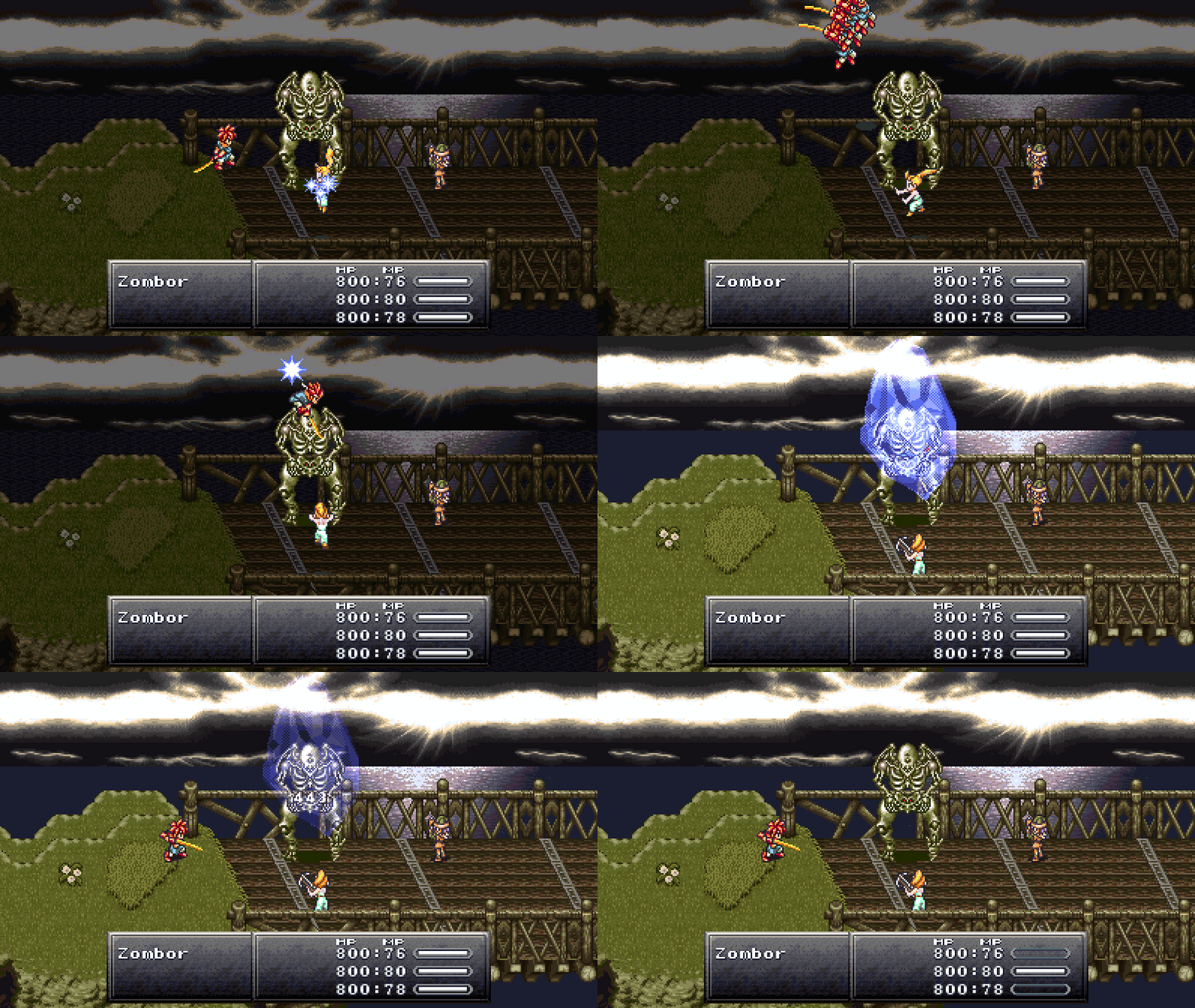
The C engine running a battle from the attract demo, graphics mods on (MP4).
BelthasarProject is named after Belthasar, the Guru of Reason who designed the Epoch. The name keeps clear of the "Chrono" trademark.
Legal notice. This repository contains no part of the game: no program code, graphics, music, text or data from the cartridge. To use it you need your own dump of Chrono Trigger (USA), made from your cartridge with a cartridge reader -- how: docs/ROM.md, following the preservation community's guide https://dumping.guide/carts/nintendo/snes. The engine, the oracle and the setup flow check the dump before they use it:
Size 4,194,304 bytes (4 MiB), headerless. A 512-byte copier header is accepted and stripped. SHA-1 de5822f4f2f7a55acb8926d4c0eaa63d5d989312(the No-Intro dump)CRC32 2D206BF7Everything derived from the ROM (the asset container, generated tables, translated stages, test states) is produced on your machine from your dump and is never distributed. See docs/ROM.md.
Chrono Trigger is © Square Enix (originally Square Co., Ltd.). BelthasarProject is not affiliated with or endorsed by Square Enix or Nintendo.
What it is
BelthasarProject is not a byte-matching disassembly and not an emulator. It is a portable C engine that behaves like the game: the field, the event scripts, battles, menus, the overworld and the sound, all re-implemented routine by routine from the 65816 code. The method is the one snesrev/zelda3 proved:
- The original ROM, run in an embedded SNES core (the oracle, built on LakeSnes), is the only source of truth.
- Every behaviour is derived from the ROM's disassembly and the oracle's RAM. Nothing is guessed, tuned by eye, or special-cased per scene.
- A routine counts as ported when the oracle and the C code agree, and a regression check pins that agreement.
The rules behind this, and the decisions that shaped them, are in docs/METHODOLOGY.md and docs/DECISIONS.md.
Screenshots
Every picture is the C engine's own output during the attract demo (not the emulator), made by
tools/release/make_media.py.
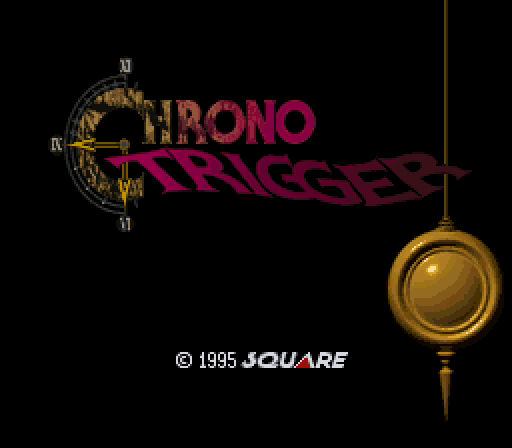 | 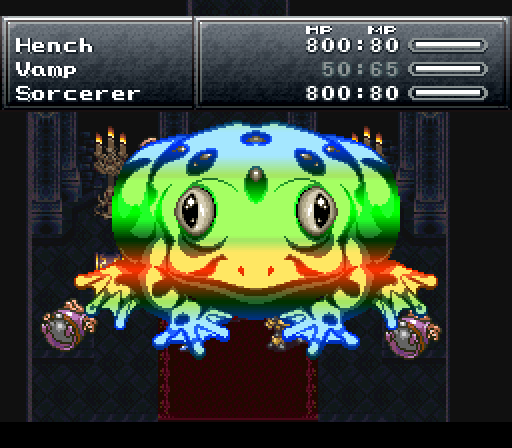 |
| The title sequence | A battle tech, vanilla 256x224 |
With the graphics mods on -- the widescreen (16:9), the Steam margins, the scene adjustments and the bottom lines filled -- the field, the overworld and battles show more of the map at the sides, and the special scenes are drawn for the wide picture:
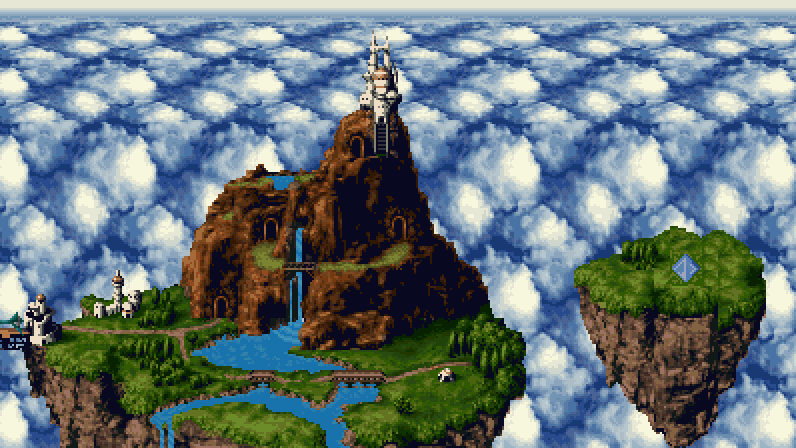 | 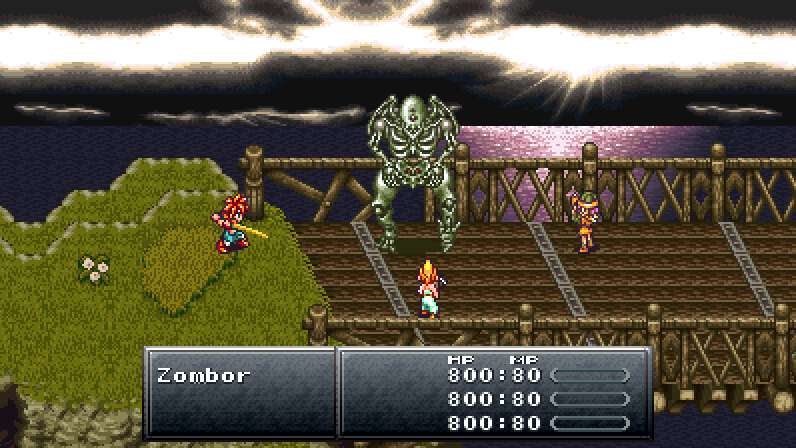 |
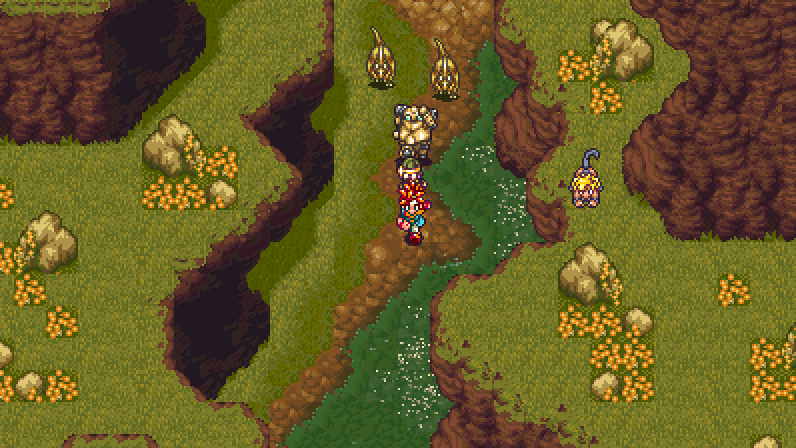 | 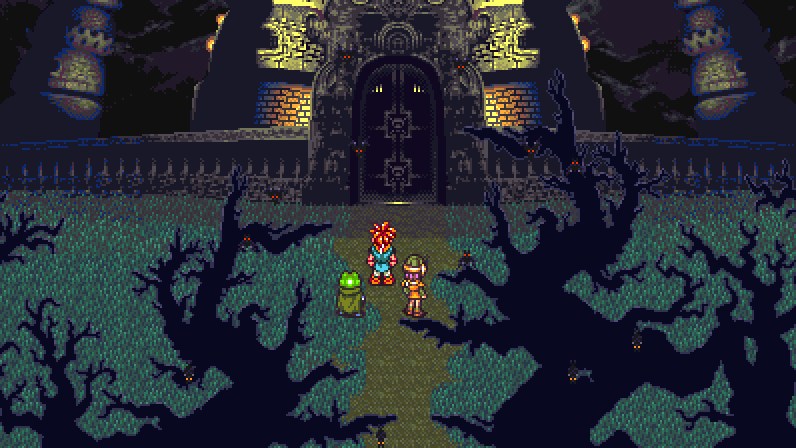 |
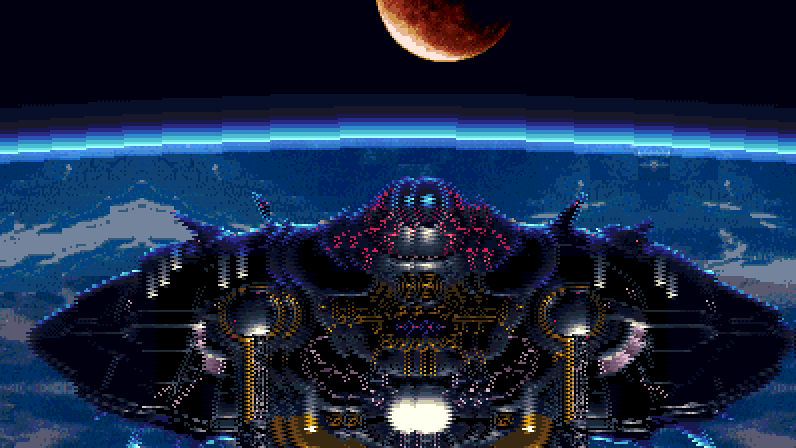
The Black Omen rising under one red moon: the scene adjustments draw it for the wide picture.
The Steam margins draw the strip the Steam release draws past each room's edge, read by the setup from the player's own Steam copy: no Steam data is in this repository or a release, only these pictures of it drawn.
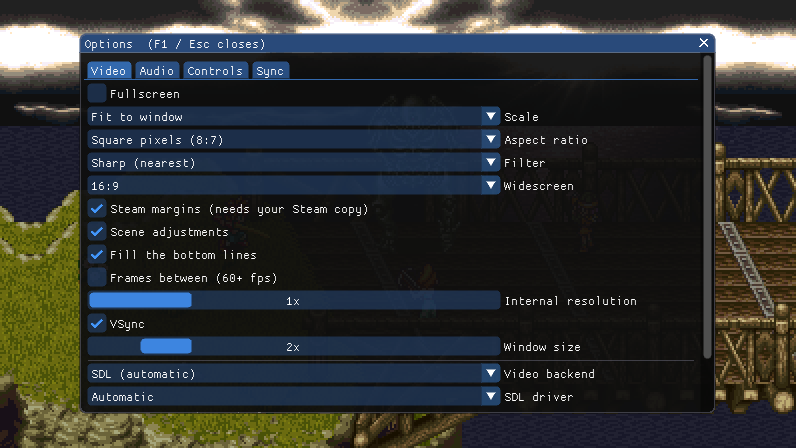
The mods are switched on in the F1 overlay. With every option at its default, the game is the vanilla game:
Status
The game boots like the cartridge does: the title sequence, the attract demo, the load screen, and a new game into Crono's bedroom. From there the field, battles, menus, shops, the overworld and the music run on the C engine. The project's owner plays it, reports what looks wrong, and each report is traced back to the ROM before it is fixed. It is not yet verified playable from start to finish.
| Area | State | Notes |
|---|---|---|
| Field | Works | Event-script VM and scheduler, collision, movers, sprite priority and draw list, camera, textbox, doors and location changes, chests, naming screen, minigames met so far (the fair, the tent of horrors), iris and window wipes, the staff roll's caption plane. The field VM covers 217 opcodes, 99.9% of all script sites. The remaining sites are two ops that reset the stack (the engine runs them as the reboot they are, but no sweep can grade them) and the ROM's own panic stub. |
| Battle | Works | ATB, the menu pass, physical attacks, techs (single, dual, triple), items, status effects, enemy AI from the ROM's condition tables, counters, death dissolve, rewards, level-up, running away. Enemy census: 253 of 255 enemy fights identical to the cartridge under the timing rule. |
| Menus | Works | All six X-menu screens (Item, Equip, Tech, Config, Save, Form), shops, the load screen. Saving writes the 8 KB battery image to ct_sram.srm. |
| Overworld | Works | Camera and tilemap streaming, the ambient-object VM (birds, boats), the ferry, party followers, zoned music. |
| Sound | Works | The bank $C7 driver upload, the song loader, the command channel, and the sound processor's program itself as C (src/sound/), sample-exact against the vendored SPC700/DSP it replaced. |
| Title and attract | Works | The title sequence is the overlay's own machine; the attract demo is audited against the cartridge frame by frame. |
| Mods (F1) | Works | Widescreen, internal resolution, frames between (60+ fps), free sync. Opt-in; with every option at its default the game is the vanilla game. |
Not done
- No check needs a private state any more (since 2026-10-23). Everything the build needs is made from your ROM, and every regression check runs in a fresh clone from your ROM, the recipes and the public battery saves. See docs/ROADMAP.md.
- The vendored core stays as the reference.
Belthasarruns no emulated hardware: the sound driver, the$C3sequence stages, the gate warp, the window wipe, the overworld window and the HDMA table builder are native C. The vendored LakeSnes core remains the oracle, the sound's reference (CT_AUDIO_SPC=ref) and the in-game lockstep (CT_FIELDLOCK); the translated programs insrc/xlat/arect.exe's references only (--xlatcmp). - Open divergences. A list of known differences from the cartridge (a few frames of timing in some battle exits and location loads, a handful of pictures) is kept in docs/ROADMAP.md.
- The playthrough is graded only partway.
tools/playthrough.pygrades one route against the cartridge leg by leg from New Game onward; how far it reaches is kept in docs/ROADMAP.md (G1).
Quick start
For experimental macOS support, see the local app build guide.
Requirements
- macOS (experimental): Xcode Command Line Tools, Python 3, CMake, Ninja, pkg-config and SDL2; see the Mac guide.
- Windows: Visual Studio 2022 Build Tools (MSVC, with the bundled CMake and Ninja) and Python 3.
- Linux: gcc or clang, CMake,
libsdl2-dev, Python 3. The Linux build is a compile-parity build, not the reference platform (see docs/INFRA.md). - Python packages:
python -m pip install -r requirements.txt(numpy, which part of the regression suite needs).requirements-optional.txt(Pillow) serves a few tools no check runs, such as the map editor. - Android (experimental): the Android SDK and NDK, built from Windows with Gradle, with on-screen touch controls; see the Android guide.
- Your own ROM, as described above.
- On Windows, clone into a short path (for example
C:\src\BelthasarProject): the build's object paths under a long directory exceed Windows' 260-character limit and the compiler check fails.
1. Fetch the libraries (not in the repository)
powershell -ExecutionPolicy Bypass -File tools\get_sdl2.ps1            :: SDL2 -> third_party\SDL2
powershell -ExecutionPolicy Bypass -File tools\get_imgui.ps1           :: Dear ImGui -> third_party\imgui (the F1 overlay)
powershell -ExecutionPolicy Bypass -File tools\get_vulkan_headers.ps1  :: Vulkan headers -> third_party\vulkan (optional backend)
Without SDL2 only the headless oracle harness ct.exe is built. Without ImGui Belthasar builds with no overlay.
Without the Vulkan headers the Vulkan backend is left out. On Linux and macOS, use the system SDL2 and fetch ImGui
with python3 tools/get_imgui.py.
2. Set up from your ROM
python tools/setup.py --rom path\to\Chrono_Trigger_USA.sfc
The setup flow (about 15-20 minutes the first time; later runs reuse what did not change):
- verifies the ROM (size and SHA-1) and copies it to
Chrono_Trigger_USA_SNES.sfcat the root; - builds a bootstrap oracle (
build/ct.exe) from the shapes of the generated files (tools/gen/shapes/: declarations and sizes, no data); - replays the recipes (
tools/recipes/): the oracle runs your ROM from power-on to every game moment the generators need; - generates the asset captures, extracts
ct_assets.dat(assets/extract_assets.py), then generatessrc/data/*.handsrc/xlat/*.c(tools/gen/manifest*.json); - packs the generated tables into
ct_tables.dat(tools/gen/pack_tables.py; a player's setup writes them inside thect_assets.datof their data folder instead); - builds everything.
python tools/setup.py --check regenerates every generated file and compares it with what is in place.
The regression suite's state fixtures are made the same way: python tools/fetch_saves.py first (the public battery
saves several recipes start from, downloaded from their sources and verified by SHA-256: tools/third_party_saves.json),
then python tools/fixtures.py make all (see docs/TESTING_OVERVIEW.md). No state file the
suite reads may exist on one machine only: python tools/input_provenance.py says where each one comes from.
3. Build
tools\build.bat :: or: python tools/build.py [target]
tools\build.bat calls tools/build.py, which checks that each target's executable was actually relinked and
refuses to build while a build\ct*.exe is running (a running Belthasar.exe locks the file). Close the game before
you rebuild.
4. Run
After the setup, ct_assets.dat at the root is all the game reads; the ROM (Chrono_Trigger_USA_SNES.sfc at the
root, or CT_ROM=<path>) is the input of the setup and of ct.exe:
build\Belthasar.exe --assets ct_assets.dat --boot       :: the cartridge's cold start: title, then load screen or new game
build\Belthasar.exe --assets ct_assets.dat --newgame    :: straight into a new game (naming, then the 1000 A.D. pan)
build\Belthasar.exe --assets ct_assets.dat --scene 5    :: drop into one field scene
build\ct_viewer.exe --datonly ct_assets.dat            :: scene browser (Left/Right scene, Space pause, F full map)
With a ROM-free ct_assets.dat (what the setup makes) the game reads nothing from the ROM: the field, battles,
menus, the overworld and the sound all come from the container (docs/ROM.md).
The battery save lives in ct_sram.srm (CT_SRAM sets another path; CT_SRAM_FRESH=1 boots an erased cart).
Controls
The keyboard is one SNES pad. A controller works too, mapped by position.
| SNES | Key | SNES | Key | |
|---|---|---|---|---|
| D-pad | Arrow keys | L | D | |
| A (talk, confirm) | Z | R | C | |
| B (cancel; hold to run) | X | Start | Enter | |
| X (menu) | A | Select | Backspace | |
| Y | S | Run from battle | hold L + R (D + C) |
Other keys: F1 (or the controller's Guide button) opens the options overlay; F5 / F9 write and read a debug
snapshot (ct_debug.*, used to report bugs); Esc quits.
The F1 options overlay
The overlay pauses the game. Settings are kept in ct_settings.ini next to the executable (CT_SETTINGS sets
another path). Headless runs never read that file, so the test suite always sees the defaults.
| Tab | Options |
|---|---|
| Video | Window or fullscreen, window size, scaling (fit / integer / stretch), aspect (square pixels or 4:3), filtering, vsync, backend (SDL with its render driver, OpenGL 3.3 -- 4.1 on macOS -- or Vulkan; applied at the next start; Android has SDL only). The mods live here too: widescreen (off, 16:9, 16:10, 21:9; plus whether a room as wide as its map continues the map into the sides), internal resolution (1x to 4x), frames between (draws the picture at the display's refresh rate between two 60 Hz frames, at a cost of one frame of latency) |
| Audio | Volume, mute |
| Controls | Key and controller bindings; the left stick as the d-pad |
| Sync | Frame-perfect (default) or free: in free mode, waits that exist only because the SNES was busy (song uploads, load stalls) cost no frames |
The mods do things the cartridge does not do, on purpose: they are outside the ROM-accuracy rule. Each is off by
default, and with everything off the game is byte-identical to the vanilla engine. What each mod covers, and what
it does not cover yet (menus are pillarboxed, the $C3 sequence stages and the gate warp have no frames between), is in
docs/ROADMAP.md.
How it is checked
build/ct.exe embeds the oracle: LakeSnes running your ROM. It can step the original game and the C engine side by
side and report the first frame where they differ (--vmdiff), cross-check all 512 field scenes (--vm), run the
ROM's own routines over generated inputs and compare them with the C version (the --sweep* modes), and dump or
watch any RAM the cartridge has (--peek, --monitor, --read). Timing is graded under "the rule", which is
zelda3's model: lag frames, beam-counter races and CPU cycle counts are removed on both sides, so the comparison is
deterministic.
python tools/regress.py runs the regression suite (--quick runs its pre-commit tier; --summary prints how many
checks each tier holds). A check passes when its
expected output lines appear, never because of an exit code, and a check whose inputs are missing is reported as
SKIP. Most checks also carry mutations: deliberate defects that the check must catch. A check that still passes with
its mutation applied is treated as a blind spot, not as coverage.
Read docs/METHODOLOGY.md for the method and docs/TESTING_OVERVIEW.md for the suite.
Documentation
| Document | What it covers |
|---|---|
| docs/ROM.md | The supported ROM, dumping it, verifying it, what is never distributed, the leak scanner |
| docs/ARCHITECTURE.md | The programs, the source layout, the data flow, each subsystem |
| docs/METHODOLOGY.md | The oracle, lockstep, sweeps, the no-invention rule, the timing rule, from RE to a pinned check |
| docs/DECISIONS.md | The dated decision log |
| docs/ROADMAP.md | What is left, by area, with where to start |
| docs/TESTING_OVERVIEW.md | The regression suite at a glance |
| docs/TESTING.md | The suite in detail: tiers, pins, per-check notes |
| docs/MUTATION_AUDIT.md | Which checks are proven to grade something, and what is still open |
| docs/INFRA.md | Build, repository layout, the oracle workflow, state formats |
| docs/DEBUG_SURFACE.md | The ct.exe and Belthasar debug modes and environment variables (tools/doc_surface_check.py lists any it misses) |
| docs/RELEASE.md | The player's release package: how it is built and scanned, the setup screen |
| docs/ANDROID.md | The Android build (experimental) |
| docs/MACOS.md | The macOS build and app bundle (experimental) |
| docs/SHADOW_PROPOSAL.md | Shadow mode: routine-level validation against the oracle |
| docs/CAPTURES_WANTED.md | Historical (2026-08): the snes9x captures once requested, now replaced by recipes |
| tools/README.md | The tooling index: where to start, the families of tools, ctlib, the conventions |
| CONTRIBUTING.md | Where a new contributor starts, the ground rules and the workflow |
| CLAUDE.md | The project mandate as given to the coding agents, with the owner's dated decisions |
| disasm/notes/ | About 280 reverse-engineering dossiers, one per mechanism |
| .claude/skills/ | Step-by-step playbooks: derive, implement, pin, capture, triage |
Credits and license
The code, tools and documentation written for BelthasarProject are under the MIT License. The vendored
LakeSnes core in snes/ keeps its own MIT license, and the libraries fetched at build time (SDL2, Dear ImGui,
Vulkan-Headers) keep theirs. CREDITS.md names everyone whose work this builds on: LakeSnes, zelda3,
CTViewer, Temporal Flux's LZ work, ctrando, the Data Crystal and Chrono Compendium communities, and others.
Much of the reverse engineering, the C and the documentation was written with Claude Code (Anthropic) under the project owner's direction. docs/DECISIONS.md records which choices were the owner's.