EC7Wolf
EC7Wolf is a source port of Corridor 7 Alien Invasion for Windows, Linux, and Android that runs the original game files natively.
- Type: PC port
- Game: Corridor 7: Alien Invasion
- Runs on Windows, Linux and Android
- By jeddhor
- Latest release v1.0-beta322, 2026-11-23
- Source: https://github.com/jeddhor/EC7Wolf
README
   ▄████▄   ▒█████   ██▀███   ██▀███   ██▓▓█████▄  ▒█████   ██▀███      ▄▄▄▄▄▄
  ▒██▀ ▀█  ▒██▒  ██▒▓██ ▒ ██▒▓██ ▒ ██▒▓██▒▒██▀ ██▌▒██▒  ██▒▓██ ▒ ██▒       ▒██
  ▒▓█    ▄ ▒██░  ██▒▓██ ░▄█ ▒▓██ ░▄█ ▒▒██▒░██   █▌▒██░  ██▒▓██ ░▄█ ▒       ░██░
  ▒▓▓▄ ▄██▒▒██   ██░▒██▀▀█▄  ▒██▀▀█▄  ░██░░▓█▄   ▌▒██   ██░▒██▀▀█▄        ▓██▒
  ▒ ▓███▀ ░░ ████▓▒░░██▓ ▒██▒░██▓ ▒██▒░██░░▒████▓ ░ ████▓▒░░██▓ ▒██▒      ██▒▒
              A L I E N   I N V A S I O N   —   the EC7Wolf source port
EC7Wolf — Corridor 7: Alien Invasion
EC7Wolf is a vibecoded, sourceless source port of the 1994 Capstone FPS Corridor 7: Alien Invasion, built on a fork of the ECWolf engine.
⚠️ This is not stock ECWolf. This fork exists for exactly one purpose: to make Corridor 7: Alien Invasion run natively on a modern machine, reading the original commercial game files, reproducing the original mechanics as faithfully as the surviving evidence allows. The engine has been surgically altered throughout for Corridor 7. Other Wolf-family games (Wolfenstein 3D, Spear of Destiny, Blake Stone, …) may still launch, but they are not the target of this fork and are not guaranteed to behave correctly. If you want a general-purpose Wolf3D port, use upstream ECWolf.
🎮 The controls are modern by default
W A S D to move · E to open doors and use machinery · arrow keys turn · Ctrl fires · Shift runs
This is not what Corridor 7 shipped with in 1994. If you want the original scheme — arrow keys to move, Space to open — the installer offers it as a tick-box, or change any key in Options → Controls. See Controls below.
What it looks like
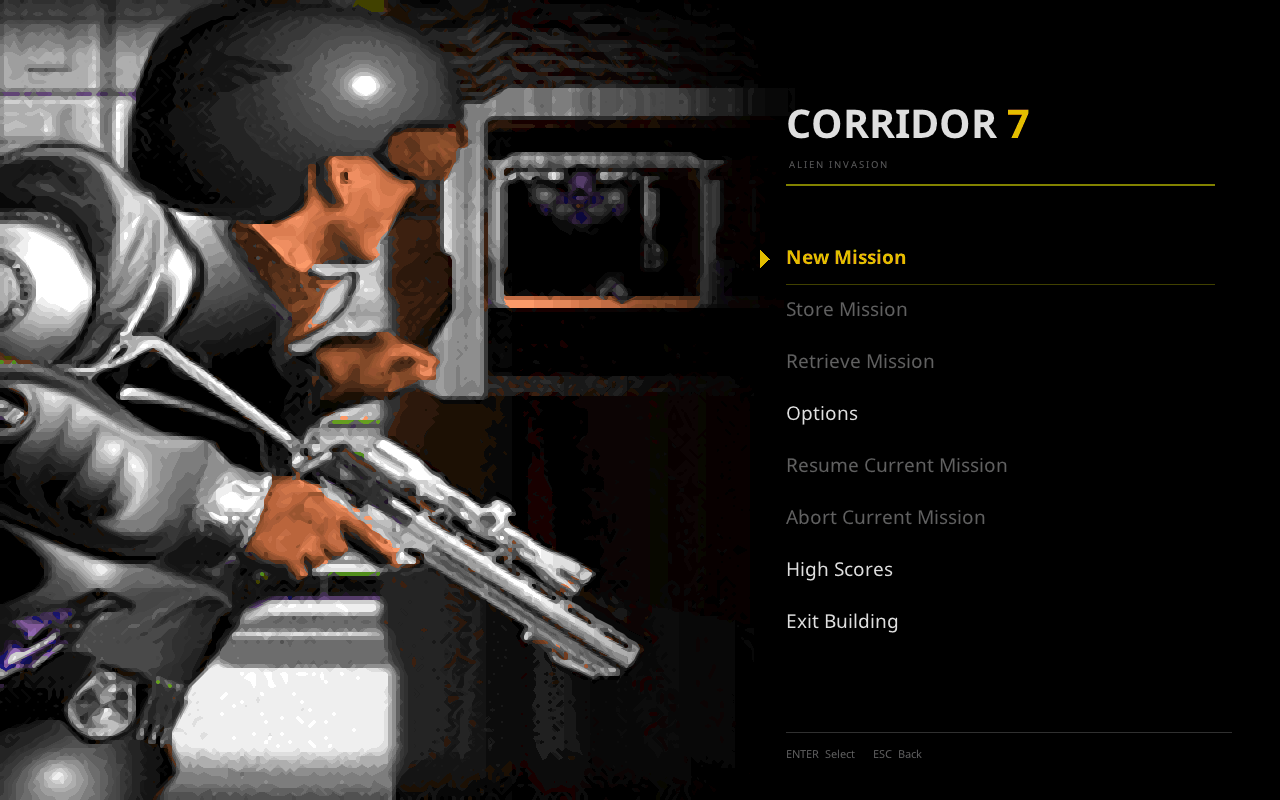 | 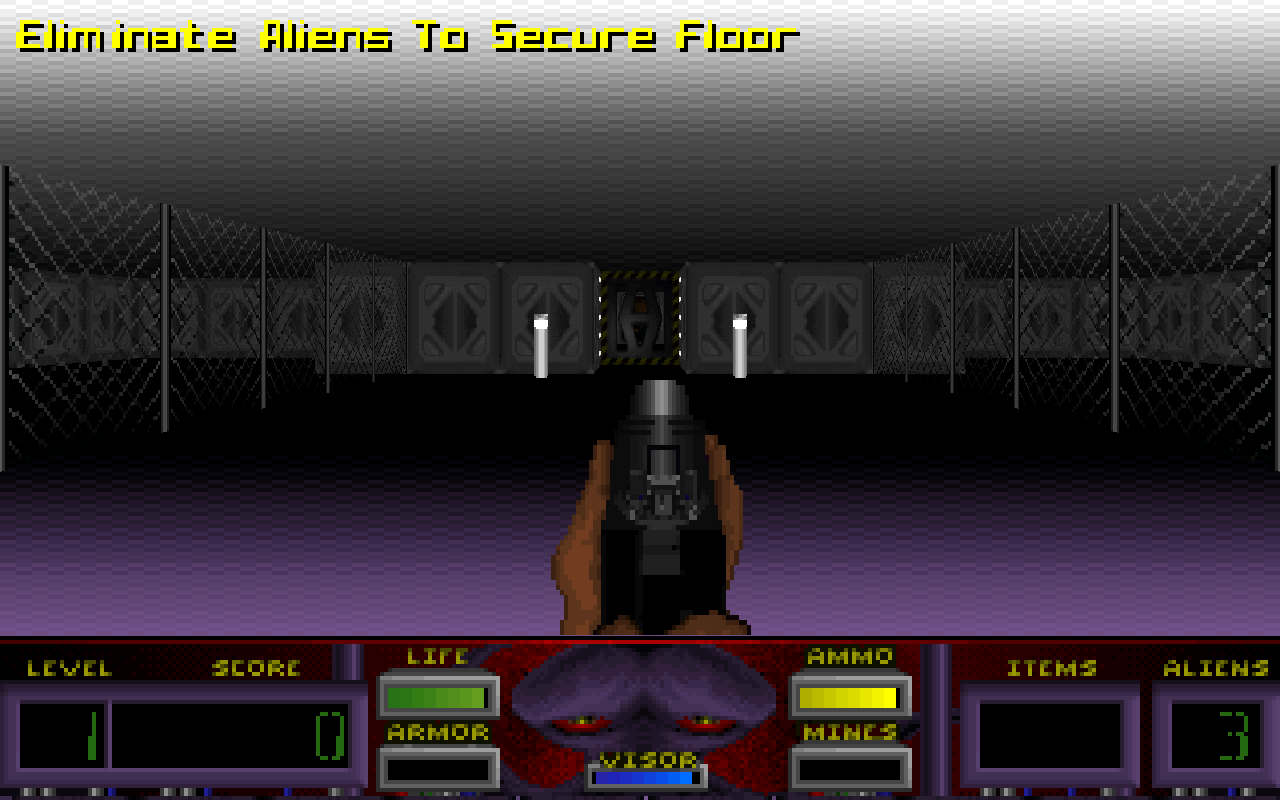 |
| The menu, rebuilt as a splash-art shell with TrueType text, over the original's own artwork. | The game, drawn by the OpenGL renderer: the floor objective banner, the original HUD, the original palette. |
Regenerate these with tools/capture_screenshots.sh BUILD_DIR DATA_DIR —
they are produced from a pinned map, seed and frame, so they can be refreshed
rather than left to go stale.
Why does this exist?
Corridor 7 has spent thirty years as one of the great almost-ported DOS shooters. Here's the situation this project walked into:
- There is no public Corridor 7 source code. Capstone/IntraCorp never
released it. What does survive publicly is the 1996 Corridor 8 prototype
source — a successor codebase that still carries
CORR7*.Cfilenames but is explicitly not Corridor 7 and cannot be treated as its source. - ECWolf "support" was promised, but never shipped. For years the plan was that ECWolf would eventually add Corridor 7 the way it added Blake Stone. The engine's Corridor 7 disassembly was reportedly mapped — but the annotated source was never made public, and playable support never actually landed. The game stayed stranded in DOSBox.
- So I did it myself — with generative AI. This entire port is a vibecoding effort: reverse-engineering the executable's behavior, reading map planes and asset containers, comparing pixel-for-pixel against DOSBox captures, and reconstructing the missing mechanics one at a time, in collaboration with a coding AI. Where the executable didn't yield an unambiguous constant, the behavior is an evidence-based reconstruction, documented honestly as such (see Known deviations below).
The result is a single native binary that boots your legally-owned Corridor 7 CD data straight into the 40-floor campaign, all six bonus floors, and final victory — no DOSBox, no emulation layer, real 8-bit ray casting.
Credits — where credit is due
This project stands entirely on the shoulders of four bodies of work. None of the underlying games or engines are mine, and the commercial Corridor 7 assets are not included here.
Corridor 7: Alien Invasion © 1994 Capstone Software / IntraCorp
The game itself — story, art, sound, level design, alien menagerie — is the creation of the Capstone/IntraCorp team:
| Role | Credit |
|---|---|
| Executive Producer | Leigh Rothschild |
| Producer | David Turner |
| Director | Amy Smith Boylan |
| Programmers | Les Bird, Jeff Schulz, Rafael Paiz, Joe Abbati |
| Artists | Ruben Cabrera, Carlos Ibarra, Scott Nixon |
| Level Design | Les Bird, Scott Nixon, Richard Henning |
| Music & Sound | Joe Abbati |
| Quality Assurance | James Wheeler, Katie Gangi |
(A fun bit of trivia the design docs confirm: many alien names are reversed staff names — SOLRAC/Carlos, TTOCS/Scott, EITAK/Katie, SEMAJ/James, TENAJ/Janet, NERRAW/Warren.)
The Wolfenstein 3D engine © id Software
Corridor 7 is built on a heavily-modified license of id Software's Wolfenstein 3D engine. The original engine architecture — the 8-bit ray caster, the map/actor plane model, the VSWAP concept — is id's.
ECWolf © Braden "Blzut3" Obrzut and contributors
This is a fork of ECWolf, itself derived
from Wolf4SDL. ECWolf's SDL2 port, ZDoom-style data formats, high-resolution
software renderer, save system, and multi-game IWAD framework are the foundation
everything here is bolted onto. ECWolf is licensed under the GPL; see
docs/license-gpl.txt and docs/copyright.
The Android touch controls and launcher © Emile Belanger (Beloko Games)
There is a playable Android build because Emile
Belanger wrote the touch-control library and the
launcher that ECWolf's Android support is built on, and then licensed them
generously: they are GPLv2, but android-libs/TouchControls/License.txt and
android-libs/launcher/License.txt grant ECWolf and products deriving from it
— which is this — the use of them under the LGPLv2.1. This port never had to
ask, because that question had already been answered.
What is here is their work with roughly 2,400 lines changed on top: the touch-control renderer ported from OpenGL ES 1.x to ES 3.0, buttons added for Corridor 7's own verbs, and a data importer, disc ripper and Vorbis encoder grafted into the launcher. The bugs in those changes are mine, not theirs — and the launcher's own text no longer names Beloko precisely because that would put their name on things they did not write.
This fork is a hobbyist preservation/compatibility effort and is not affiliated with or endorsed by Capstone, id Software, the ECWolf project, or Beloko Games.
About Corridor 7 (the game)
In 2012, Dr. Donald Fox returns from Mars with an ageless metallic object recovered near a face-like formation. The government moves it to Delta Base, an underground Nevada weapons complex. Gamma testing turns it into a gateway; armed aliens pour through, killing the staff and converting both the facility and its atmosphere. A lone special-forces Marine is sent down to descend Corridor 7, restore contact, and destroy the object.
Corridor 7 (1994) is a first-person shooter that looks like Wolfenstein but plays with a whole extra layer of systems grafted on:
- 40 floors of campaign (Delta Base floors 1–30, then a teleporter-linked alien world 31–40 on the CD release) plus six hidden bonus floors, ending in a multi-stage guardian boss and a final vortex.
- A "secure the floor" objective — the exit isn't just an elevator. Each rank must kill a percentage of the floor's aliens (Corporal 10%, Lieutenant 75%, Captain/Major 100%) before it will let you leave. The HUD's aliens-remaining counter is the win condition.
- A three-mode visor — Normal, Night Vision, and Infrared, drawing from a battery. Infrared is not a gimmick: it's how you see cloaked Enirams, invisible laser barriers, and which security terminals are safe.
- A proximity map that doubles as a motion detector — moving aliens show as blue dots, armed mines as red, revealing threats through walls once you find the Floor Plan.
- Eight weapons across two ammo economies — human weapons (Taser, Assault Shotgun, M-24 C.A.W., M-343 Tribarrel) draw from a shared 200-round pool; alien weapons (Dual Blaster, Plasma Rifle, Assault Cannon, Disintegrator) draw from a separate 999-unit energy pool. Plus proximity mines you plant and back away from.
- A living, interactive base — wall-mounted health/ammo dispensers, health chambers that seal you in and heal you, security computers that issue per-floor access cards or trip alarms, four-frame animated conversion machinery, glass and see-through walls, sliding/rising/force-field doors, and hazards like electrified walls and the infamous infrared-only laser barriers.
- A bestiary of 16 aliens (CD) — from 25-HP Alioprobe sentries to the cloaking Eniram, the furniture-mimicking Bandor, and a five-stage final guardian (Tebazile → Eniram Boss → Tymok → Solrac → Tebazile).
Technical profile (original DOS release)
| Year / Publisher | 1994 · Capstone Software / IntraCorp |
| Engine | Modified licensed Wolfenstein 3D engine |
| Retail executable | CORR7CD.EXE (CD, 250,776 bytes) / C7.EXE (floppy) |
| Map container | MAPTEMP.CO7 — RLEW-compressed planes (no Carmack layer) |
| Map header | embedded in the executable (CD offset 0x30D50), not a MAPHEAD file |
| Walls & sprites | GFXTILES.CO7 — single wall images with runtime shading (not Wolf3D's light/dark pairs) |
| Digital sound | AUDIOMUS.CO7 — PCM at ~9009 Hz (Wolf3D used ~7042 Hz) |
| Music / SFX | AUDIOT/AUDIOHED family — 34 AdLib/IMF music chunks |
| UI / fonts / screens | VGAGRAPH / VGADICT / VGAHEAD family |
| Map grid | 64×64 tiles, three parallel planes (wall/floor, object/actor, editor) |
| Min spec | 386-25, 590 KB free conventional RAM, 2 MB RAM, VGA, MS-DOS 5.0+ |
Much of this is why the port needed engine surgery rather than a data mod: Corridor 7 stores its map header inside the .EXE, ships single wall images instead of paired light/dark pages, hard-codes its digital-sound page metadata in the executable, and adds entire subsystems (glass, animated walls, force-field doors, visor vision, a motion-detector map) that stock Wolf3D simply does not have.
What this fork changed in the engine
Everything below is implemented directly in the engine/data of this fork specifically to reproduce Corridor 7's mechanics. Original ECWolf/Wolf3D behavior for other games was preserved wherever possible; these are the deltas.
Asset loading & file formats
- Self-contained TED5/
MAPTEMP.CO7map loader for all 60 archived maps, reading the executable-embedded map header (CD offset0x30D50) and RLEW-only plane decompression, with strict 64×64 validation. (gamemap.cpp,gamemap_planes.cpp,filesys.h,wl_iwad.cpp) GFXTILES.CO7walls & sprites exposed as zero-based wall pages (map wall ID − 1) across the full solid-wall range, including marker-104/105 masked overrides and Corridor 7's wall/plane depth ramps. (resourcefiles/file_vswap.cpp,textures/wolfrawtexture.cpp,textures/wolfshapetexture.cpp)- Executable palette extraction — the six-bit VGA palette is read from the
original executable at runtime and expanded exactly; nothing commercial is
embedded or redistributed. (
v_palette.cpp,v_palette.h) AUDIOMUS.CO7digital sound at the game's native ~9009 Hz, plus the 34 AdLib music chunks andVGAGRAPH-family fonts/screens/HUD art. (sndinfo.txt, resource loaders)
Rendering
- Single-image walls with runtime shading instead of Wolf3D light/dark
pairs. (
textures/wolfrawtexture.cpp,textures/flattexture.cpp) - Glass and see-through walls — color-key transparency with freshly traced
scenery behind it. Native 104/105 glass preserves its foreground corner faces
and selects the first glass cell per view ray, as DOS does. (
wl_draw.cpp,r_sprites.cpp) - Animated walls & force fields — all four native 208..239 wall/force-field
palette cycles and four-frame in-place force-field/animated-wall openings.
(
v_palette.cpp,wl_draw.cpp) - Index-255→0 normalization so transparent-wall and door pixels stay collision-safe.
Map translation, doors & triggers
- Full plane-1 object dispatch table — statics, pickups,
difficulty/direction actor variants, bosses, and ignored markers. (
xlat/corridor7.txt,lnspec.cpp) - Four sliding door types with automatic orientation, non-sliding
rising/inside-out/force-field doors, red/blue per-floor access cards,
one-shot secret and utility pushwalls with correct restricted-secret
scoring (
0x62counts,0x65doesn't), four-frame retracting barriers, paired intralevel teleporters, floor exits, marker-99 bonus elevators, and the level-30/40 exit vortex. (gamemap.cpp,lnspec.cpp)
Actors & gameplay
- A Corridor 7 player and the full eight-weapon arsenal (including the
Ithaca/Assault Shotgun secondary animation), proximity mines, all weapon
pickups, and the two-pool ammo/energy economy. (
actors/corridor7/player.txt,wl_act2.cpp) - The 16-alien bestiary with per-rank health tables, distinct
directional/attack/pain/death sprite families, cloaking (Eniram) and
camouflage/morph (Bandor) transformations, audible projectiles, bosses,
alien-energy regeneration/capacity, and persistent mines.
(
actors/corridor7/monsters.txt,actors/corridor7/statics.txt,wl_state.cpp,wl_act2.cpp) - Non-wasteful pickup rules for health and ammunition, matching the
original's refusal to over-fill. (
g_shared/a_inventory.cpp)
Vision, HUD & hazards
- Three visor modes — Normal / Night Vision / Infrared — implemented as
whole-screen palette swaps with a draining charge, plus infrared-revealed
cloaked enemies and laser barriers. (
wl_play.cpp,v_palette.cpp,r_sprites.cpp) - The infrared "invisible laser barrier" (strategy-guide hazard, map objects
28/84): floor-to-ceiling laser statics beside the yellow health-unit doors,
invisible in normal/night vision, drawn only under infrared as animated
bright dashed energy, that never block movement but zap the player 10
points through the rank/armor path on a cooldown as you pass through — exactly
as the retail executable's
2f28:06d3routine does. (r_sprites.cpp,wl_agent.cpp,actors/corridor7/statics.txt) - Electrified walls (IDs 6/14) — solid, visible in every visor, dealing a
flat 2 points ~twice per second on contact with the DAC shock flash.
(
wl_agent.cpp) - The original status bar — segmented color gauges, number placement,
aliens-remaining counter, M-16 start selection, and native first-person weapon
scaling. (
g_wolf/wolf_sbar.cpp)
Interactive machinery
- Stateful access/alarm computers, health & ammo dispensers, the reusable
visor charger, and health chambers that turn you toward the exit, seal the
door, consume stored power, heal, and report remaining charge. (
lnspec.cpp,wl_state.cpp)
Menus, progression & presentation
- The original graphical main menu — the full-screen VGA menu picture with
painted-in entries, the 24×8 blinking arrow cursor at the original
coordinates, correct entry wiring, and DMA-capture-verified menu sounds
(cursor move = sample 9, back = 33, quit prompt = 31, activate silent).
(
wl_menu.cpp,m_classes.cpp) - Full-screen picture pages (status report, high-score, death report) drawn
in the same stretched 320×200 mapping as the artwork, verified against DOSBox
screenshots. (
wl_inter.cpp) - Rank/difficulty & campaign flow — five rank choices (including randomized
President placement), the 10/75/100/100% alien objective gate, body armor,
MAP01→MAP40 progression and victory, six routed bonus maps, per-floor hit/miss
awards, loading/death/high-score pages, and the rare non-counting
C718–C725 red-skull taunt. (
wl_game.cpp,wl_inter.cpp) - The campaign music selector, including its randomized late/bonus-floor
behavior, exposing all 34 AdLib chunks directly. (
wl_inter.cpp)
Documentation
| Document | What it is |
|---|---|
docs/corridor7.md | The exhaustive feature list, every reconstruction and how it was established, and the honest list of deviations. |
docs/corridor7-monster-sprite-workflow.md | The master AI workflow for turning a short monster idea into a complete, palette-correct set of Corridor 7 sprite angles, states, previews, and an EC7Wolf companion mod. |
docs/corridor7-level-editor.md | The complete product design, native-format contract, validation and test strategy, and phased AI-agent implementation plan for a simple point-and-click Corridor 7 level editor. |
docs/ec7edit-manual.md | The EC7Edit manual. Everything from first run to map packs, illustrated with screenshots generated from the editor itself. |
editor/ | EC7Edit, the level editor built to that plan: a Qt application, the native codec, the preview-WAD and map-pack exporters, and the ec7edit command line, with the byte layouts documented in editor/docs/native-formats.md. It ships as a self-contained package holding its own Python and Qt. |
docs/corridor7-technical-strategy-compendium.pdf | Evidence-graded research dossier on the original game: mechanics, weapons and actors, map format and object codes, asset containers, executable offsets, and what changed from stock Wolfenstein 3D. Every claim carries an evidence grade, so a confirmed retail behavior is never mixed up with an inference. It is the reference this port was built against. |
docs/renderer/ | The renderer redesign, one document per phase — baseline and harness through the OpenGL cutover, hardening and optimization. |
docs/corridor7-video.md | The CD cinematics: what is on the disc, the FLIC format they are in, and how extraction and playback work. |
docs/multiplayer.md | Network play, milestone by milestone: what the original had, what the map archive turned out to contain, what was reconstructed and from what evidence, and every wrong turn taken on the way. |
docs/undefined-behaviour.md | The 138 UndefinedBehaviorSanitizer findings inherited from ECWolf and ZDoom: what each class of them is, which six are ordinary bugs worth fixing, and the staged plan for the rest. |
docs/android.md | The Android port: every milestone, what each one cost, the measurements behind the performance defaults, and the traps — from the touch overlay's four silent failures to a file picker that ignores injected input. |
docs/ci.md | The gate suite and what CI can and cannot run. |
Getting the game data (required)
This repository contains no Corridor 7 game data. You must own a legal copy
of Corridor 7: Alien Invasion (the CD release / a Steam or GOG package wraps the
same DOS files). From your installation, copy these files into a single
directory — call it CO7:
CORR7CD.EXE     ← main executable (contains the map header & palette)   REQUIRED
MAPTEMP.CO7     ← RLEW-compressed map planes                            REQUIRED
GFXTILES.CO7    ← walls & sprites                                       REQUIRED
VGADICT.CO7     ← Huffman dictionary for VGAGRAPH                       REQUIRED
VGAHEAD.CO7     ←