Donpachi Arcade port
Donpachi Recomp is a native Windows and Linux port of the arcade shooter Donpachi, preserving its original slowdown.
- Type: PC port
- Game: DonPachi
- Runs on Windows and Linux
- By CapsLock4284
- Latest release v0.9.0, 2026-11-15
- Source: https://github.com/CapsLock4284/DonPachi-Recomp
README

DonPachi Recomp
A huge thank you to cheviman, author of arcade-decomp: without it, this project would never have started.
A native Windows and Linux port of Cave's 1995 arcade shooter DonPachi (US version), made by decompiling the arcade board's 68000 program into C and running it on a model of the Cave hardware. No emulator: the game's own logic runs natively, frame for frame the same as the arcade original.
This repository contains no game data. You need your own copy of the arcade ROM set (MAME's donpachi.zip).
The game reads its graphics, sound and data from it.
The arcade's slowdown, exactly
In DonPachi, slowdown is part of the game. When the screen fills with bullets, the board's 16 MHz 68000 can't finish a frame's work before the screen refreshes, so the game waits a frame and everything slows for a moment. Players lean on it to thread the densest patterns, and the boss fights feel different without it.
A native port normally runs the game's code in no time at all, so it never slows down. DonPachi Recomp puts the slowdown back the way the board makes it:
- Every instruction counts its time. The decompiled C carries each 68000 instruction's cycle count, including the ones that depend on their data (multiplies, divides, shifts) and on which way a branch goes.
- The VBLANK lands between the same two instructions as on the board. The 68000 decides whether to take an interrupt at one step inside each instruction; the port knows that point for every instruction form, taken from MAME's cycle-exact 68000 core.
- Checked against MAME, frame by frame: about 29 minutes of play (100,000 screen refreshes), and every one of the 96,389 frames of the game matched MAME's 68000: the same board state, the same frames slowed down, every interrupt on the same cycle.
It's on by default. GAME OPTIONS > SLOWDOWN turns it off if you'd rather play at full speed all the time.
Screenshots
Download and play
- Get the latest release from Releases:
DonPachi-x.y.z-win64.zipfor Windows,DonPachi-x.y.z-linux-x64.tar.gzfor Linux. - Windows: unzip it somewhere you can write to (not inside Program Files) and run
donpachi.exe. Windows may show "Windows protected your PC" because the program isn't signed: click More info → Run anyway.
Linux: unpack it (tar xzf DonPachi-x.y.z-linux-x64.tar.gz) and run./donpachi. It uses the system's SDL2 (sudo apt install libsdl2-2.0-0on Debian/Ubuntu,libsdl2-compaton Ubuntu 25.10 and later,dnf install SDL2on Fedora,pacman -S sdl2on Arch, if it isn't there already). - On the first run a window asks for the ROM set: drag
donpachi.ziponto it. The game extracts what it needs once (donpachi_usa.dat, beside the program); after that the .zip isn't needed. Merged and non-merged MAME sets both work.
The Japanese version: VERSION on the main menu switches to the original Japanese release (MAME's donpachij,
Ver. 1.01, with its smaller hitbox). The first time it needs donpachij.zip (beside donpachi.zip in the rom folder,
or dropped on the window that asks); it is extracted to donpachi_jpn.dat. Each version keeps its own high scores and
arcade settings; achievements and statistics are shared. To build it in, decompile it too:
python tools/decompile.py --set japan (writes src_jpn/), then build as usual.
Cheats: the Cheats page (Settings > Game Options > Cheats) has the game's own: infinite lives, infinite bombs,
invincibility, MAX power and an endless chain, for each player. For more, add MAME's cheat file for DonPachi (not
included): take donpachi.xml out of MAME's cheat.7z (from Pugsy's Cheats) and put
it in a cheats folder beside the program, as cheats/donpachi.xml; its cheats are listed after the game's own.
The Cheats page also has AI PLAYER 2, and Game Options > Debug Tools brings back the developers' own debug
mode and RAM editor, still in the arcade program (the page lists their controls).
The release's README.txt has the controls, hotkeys and the list of files the game keeps. What's new in each
version: CHANGELOG.md.
Features
- The arcade game, exactly: checked frame by frame against MAME's 68000 core through both loops
- The arcade's slowdown, at exactly the same moments as the real board (see above); can be turned off
- Low input lag by default, with the board's own timing as an option
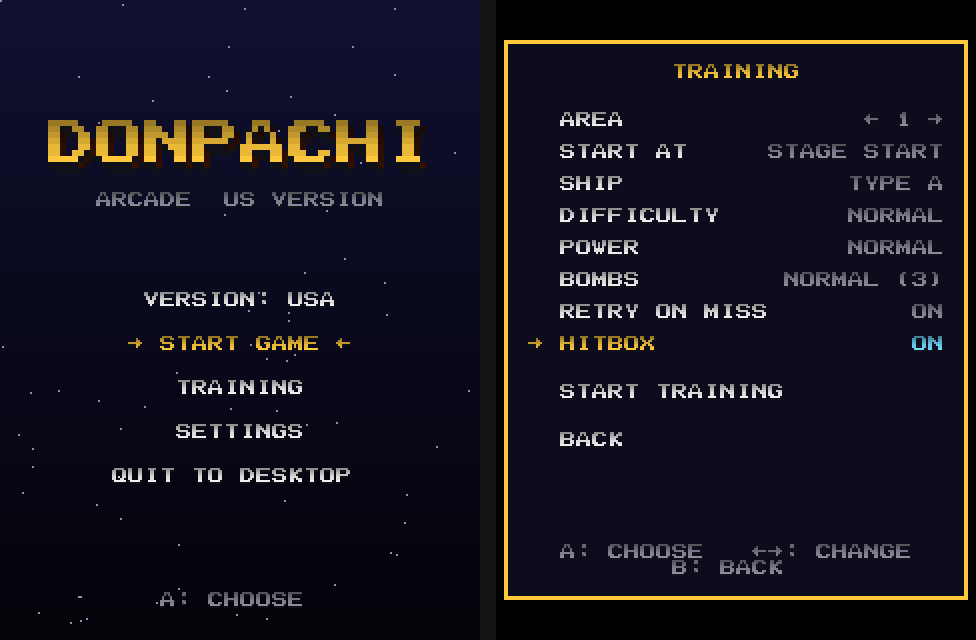
- Main menu with Training: start at any area, any point part way through it (5-95% of the way to the boss), its mid-boss, its boss or area 10's true boss, with your choice of ship, power (any level, or "on pace" for that point), bombs and difficulty, and retry on a miss
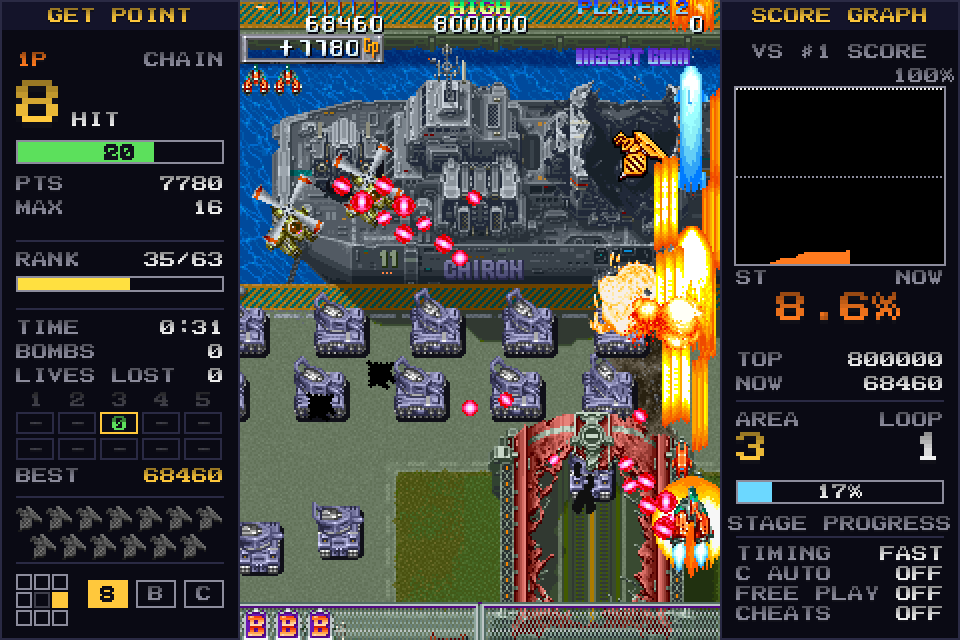
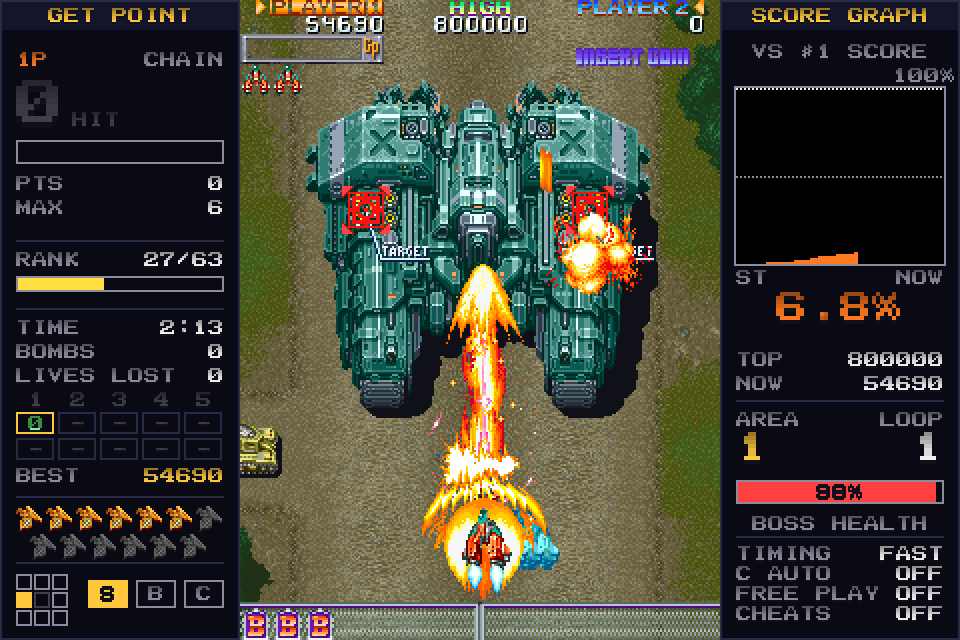
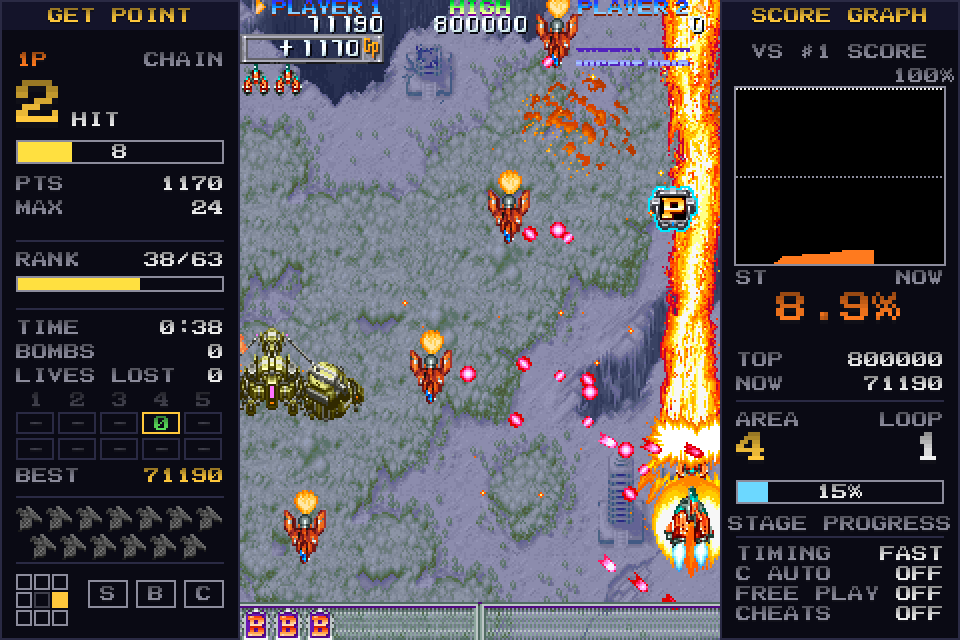
- Side panels on wide screens: chain (GP) gauge, rank, run statistics, bees collected, score graph against the top score, stage progress and boss and mid-boss health
- AI player 2: the computer flies player 2 beside you, joining by itself (it counts as a cheat)
- Save states in 5 slots, fast forward, hitbox display, high scores saved between sessions
- 26 achievements, with a pop-up when one is earned (arcade games only: not training, cheats or save states)
- Replays: every arcade game (and training run) is recorded; save it as a small file you can share, and watch them from the main menu's REPLAYS, with pause and frame-by-frame stepping; rename or delete them there
- Lifetime statistics: games, play time, clears, bosses, deaths, bombs, bees, best chain and scores, per ship and per area (arcade games only)
- Menu tooltips on the side panel, explaining each option
- Graphics: a CRT look (a curved screen with scanlines, phosphor stripes and glow), pixel-art filters (Scale2x, Scale3x, xBR 2x/3x/4x, MMPX), scaling modes, smoothing, scanlines, vsync, TATE rotation, borderless or exclusive full screen
- Game options: difficulty, autobomb (a bomb set off when you are about to be hit), free play, the arcade's hidden big HIT display, the arcade's test menu, cheats (built in, and MAME's cheat file's)
- Keyboard and gamepads (Xbox layout, two players), everything remappable, settings in
donpachi.ini
Building from source
The decompiled C isn't in the repository (it comes from the ROM), so a build makes it from your own ROM set first.
Windows needs: Git, Python 3, CMake 3.20+, Visual Studio 2022 (C), and SDL2's development package
(SDL2-devel-2.x.x-VC.zip from libsdl.org).
git clone --recursive https://github.com/CapsLock4284/DonPachi-Recomp.git
cd DonPachi-Recomp
# 1. your ROM set:            rom\donpachi.zip
# 2. SDL2's package unpacked: build\downloads\sdl2\SDL2-2.x.x\
python tools/decompile.py                       # writes src\ (the game's C) from the ROM
cmake -S . -B build/msvc
cmake --build build/msvc --config Release      # build\bin\donpachi.exe
Linux needs: Git, Python 3, CMake 3.20+, gcc or clang, and SDL2's development files (WSL's Ubuntu works too):
sudo apt install git python3 cmake build-essential libsdl2-dev     # (Debian / Ubuntu; on Ubuntu 25.10 and later: libsdl2-compat-dev)
git clone --recursive https://github.com/CapsLock4284/DonPachi-Recomp.git
cd DonPachi-Recomp
# your ROM set: rom/donpachi.zip
python3 tools/decompile.py                                         # writes src/ (the game's C) from the ROM
cmake -S . -B build/linux -DCMAKE_BUILD_TYPE=Release
cmake --build build/linux -j                                       # build/bin-linux/donpachi
tools\make_release.ps1 (Windows) and tools/make_release.sh (Linux) package a release (an allow list of files,
checked for anything from the ROM before it's packed). tools/make_appimage.sh can make a Linux AppImage (SDL2 built
from source inside it; not part of the releases for now).
Project layout
| Folder | What's in it |
|---|---|
runtime/ | the board model: memory map, video (tile layers, sprites), sound (two OKI M6295s, NMK112), EEPROM, ROM set reader |
ports/sdl2/ | the game (Windows and Linux): window, menus, settings, training, side panels, save states |
ports/headless/ | a windowless build for testing and frame-by-frame checks |
tools/ | the decompiler's game profile, analysis tools, the reference checker (tools/cref), packaging |
symbols.txt | names for the program's functions and RAM (addresses and names only) |
TODO.md | the plan, and notes on what's been found in the game |
rom/, src/, assets/, build/, release/ and *.dat are git-ignored: anything derived from the ROM stays on
your own machine.
Credits
- DonPachi is © 1995 Cave / Atlus. This is an unofficial fan project, not connected with or endorsed by them.
- The decompiler core is arcade-decomp (in
tools/core, from a fork that adds the 68000's timing for the slowdown); the runtime and build follow tmntarcade-decomp's (Sebastian Toyos, BSD-3-Clause). - The hardware model follows MAME's Cave drivers (Luca Elia and the MAME team, BSD-3-Clause).
- SDL2 (zlib license).
- The FILTER setting's scalers are this project's own code, after the published algorithms: Scale2x/Scale3x (EPX, as AdvanceMAME describes it), xBR (Hyllian, whose shaders are under the MIT license) and MMPX (Morgan McGuire and Mara Gagiu, 2021, MIT license).
- Bee counts from the shmups wiki.
License
The project's own code is under the BSD 3-Clause license (see each file's header). The game itself is not included and not covered by it.